
Brooks School Spotlight: Anne Byrne, Incoming Faculty Director of MS Programs
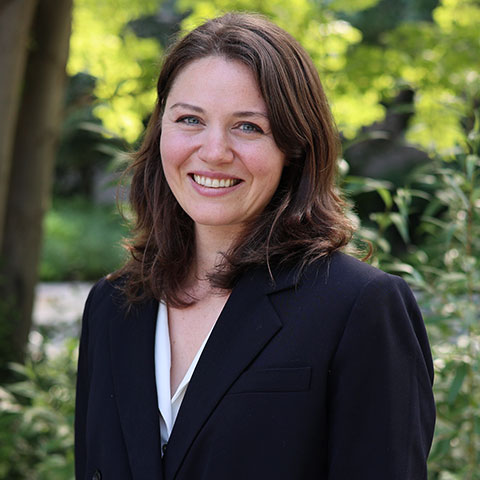
Meet Anne Byrne, Assistant Teaching Professor, Incoming Faculty Director of MS Programs
Anne Byrne is an applied microeconomist with expertise in data analysis, food policy, and the economics of private food assistance.
She teaches courses in data visualization, regression analysis, and managerial forecasting. In June, she will begin serving as the Faculty Director of MS Programs, overseeing the Brooks School’s three new Master of Science degrees.
Q: Could you tell us about your path to teaching at Cornell?
In my life before graduate school, I was a math tutor and secondary math teacher, and I’ve always loved teaching. Knowledge and skills can never be taken away from you, and being able to share knowledge and skills with students is incredibly rewarding.
After graduate school and before coming to Brooks, I was working in a research role with the federal government and I was teaching at Syracuse University as a part-time adjunct professor. The research job felt policy-relevant and my colleagues were fantastic, but I hit this point where it was like— teaching students is absolutely the best part of my work day. It made sense to seek out an opportunity that would put me in contact with students more. Then this opportunity came up and was a perfect fit.
Q: Could you tell us about your research in food and nutrition policy and what drew you to this field?
I was an applied math major, a math tutor, and a prep cook during my college years. And while there are many college students who have a clear vision of their path forward, that wasn’t me — I just knew what I liked and what I didn’t like. Things clicked when I learned more about the field of applied economics, especially the branch that focuses on food, resource, and agricultural economics. I realized I wanted clear, meaningful applications of my quantitative skills.
Ultimately, food was the application I was most interested in because it’s such an essential part of life. And as I’ve learned more, I’ve discovered all the ways that food intersects with so many other policy areas—environmental topics, health care, transportation, and economic development, just to name a few. It’s a really interesting gateway into the broader policy environment.
Q: What are some insights from your food assistance research?
One key insight from my work on food banks and food pantries is the importance of measuring impact. We can say that reductions in SNAP benefits will increase demand at food banks—but how much? What do food banks and pantries need to have to be equipped to meet that increased demand? Or we can say, food from food pantries has economic value—but again, how much? What’s the equivalent dollar value for families and neighbors? My research has aimed at these kinds of questions, which require measurement and data to answer.
Another insight is just how incredible food assistance organizations, like food banks, are. They are managing the logistics of perishable food, coordinating supply chains, distributing resources equitably, and often doing it with limited budgets and heavy reliance on volunteers. And their ability to pivot in moments of community-level need or crisis is truly remarkable. I think we can all learn a lot from these operations.
Q: What kinds of issues did your work as a research economist with the Economic Research Service address?
The Economic Research Service is a principal statistical agency for the U.S. Department of Agriculture, so they don’t make policy recommendations—they produce statistical and analytic reporting to inform policy. There’s a firewall between the two, which preserves the independence of the federal statistical system. I worked on Food Markets, including retail food environments, food prices, and some food assistance topics.
Q: You teach PUBPOL 5840: Data Visualization for Public Policy. Why is data visualization such a critical skill for today’s policy professionals?
People don’t often want to look at tables when they’re trying to get a sense of the underlying story. They want to see what’s happening visually. Quantifying effects, comparisons, and trends is really important to achieve shared understanding among key stakeholders, so I train students to create visualizations that are effective, honest, and engaging.
Q: You also teach PUBPOL 5690: Regression Analysis and Managerial Forecasting for Master of Health Administration students. How will students use these skills in their careers?
This course is about developing analytical tools so students can work with numbers to uncover solutions to problems in health care organizations. Health care organizations are tasked with providing excellent care within the realities of budgets, complex organizational charts, and highly technical systems. These quantitative tools help students navigate that complexity and make informed decisions in environments that are absolutely critical to people’s lives.
Q: What excites you most about the new MS in Data Science for Public Policy programs at the Brooks School?
The students will understand data and policy, learn the language and tools of both data and policy analysis, and use quantitative analysis to create shared understanding in policy-relevant contexts. Putting numbers on problems helps us understand how big they are and whether solutions are actually working. That’s essential for evidence-based policymaking, and I’m excited to work with these students as they grow and put their analytic skills to work.
Q: As an alumna, what’s your favorite spot on campus for a break?
I love the Johnson Museum, especially the top floor where you can look out over the lake. It’s a peaceful spot, and a reminder of the richness of both culture and natural beauty we have here in Ithaca and on the Cornell campus.
Q: What’s your perfect afternoon in the Finger Lakes?
My daughter has just reached the age where she can hike Taughannock on her own. As she grows up, we’ll tackle Buttermilk, Treman, and maybe even the Abbott Loop someday. But for now, sandwiches from Creekside Cafe and a hike to Taughannock Falls with my spouse and our daughter is pretty much perfect.